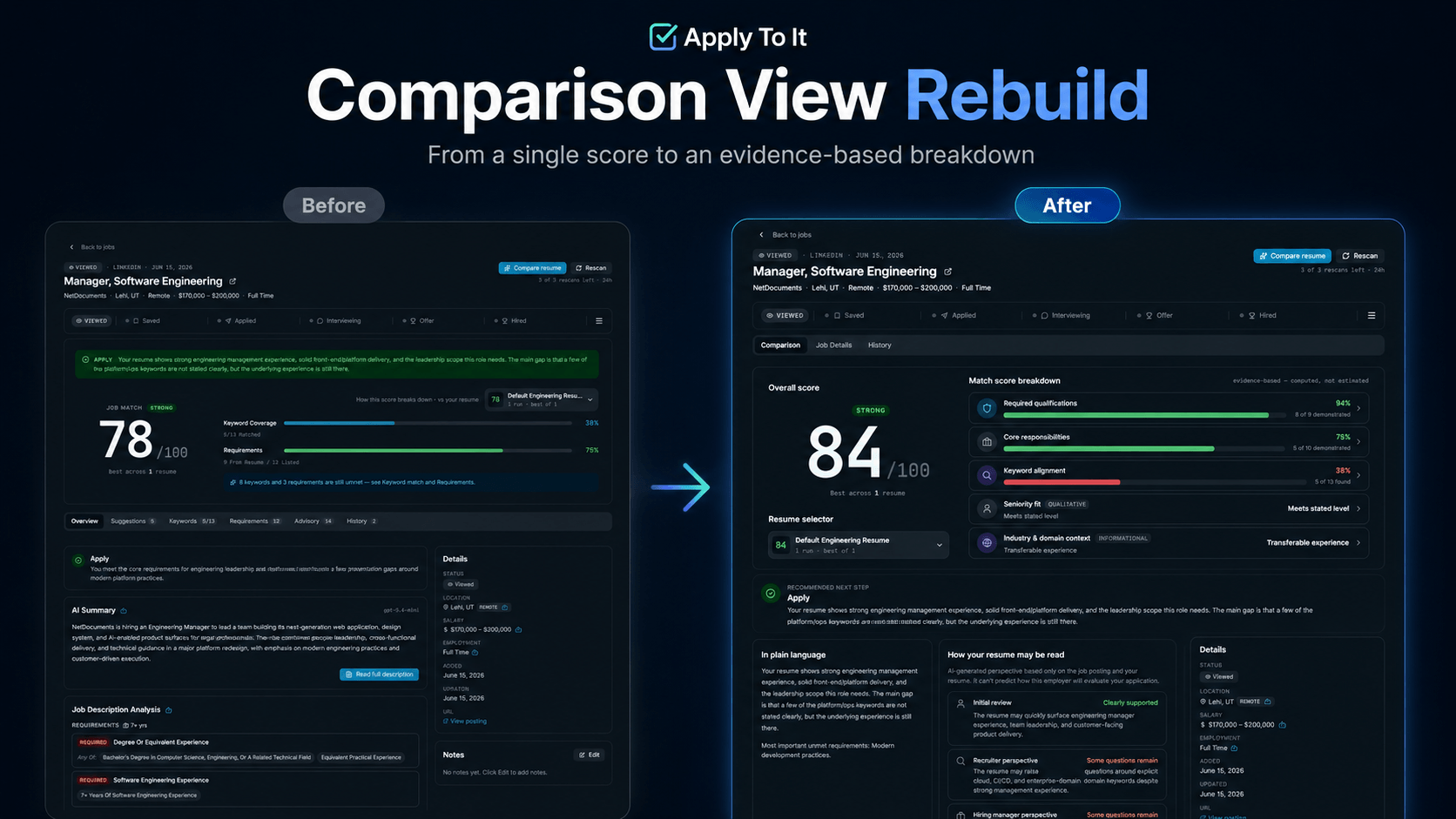
The comparison view is at the heart of Apply To It. It helps you decide whether a role deserves more of your time.
But when the result started to feel like a number without enough explanation behind it, we knew it needed to change.
So we rebuilt it.
Here’s what changed, and why.
The problem with a single number
A Job Match Score can be useful, but a number on its own can quietly mislead you.
A high score can create false confidence. You apply, never hear back, and still have no idea what may have been missing. A low score can be just as unhelpful. It can discourage you from pursuing a role you may be qualified for simply because your resume did not communicate that experience clearly enough.
Either way, a number alone does not answer the question you actually have:
Why did I receive this score?
The goal was never a bigger number. It was a clearer one — supported by reasons you can evaluate for yourself.
The score now shows its work
The rebuilt comparison view is organized around the factors that contribute to fit. Instead of seeing only one score, you can review the evidence behind several dimensions:
- Required qualifications — the must-haves listed in the role and how clearly your resume demonstrates them.
- Core responsibilities — what you would be doing day to day and whether your experience supports that work.
- Keyword alignment — the specific terms and phrases the posting emphasizes, and which of them actually appear in your resume.
- Seniority fit — whether your demonstrated level, ownership, and scope align with what the role expects.
- Industry and domain context — when specialized experience genuinely matters to the role.
Open any dimension and you can see what the job asks for, what evidence appears in your resume, what may be missing or unclear, and why that dimension contributed to the result.
The score no longer has to stand on its own.
The rules we held ourselves to
A breakdown is only useful when it is honest about what it can and cannot determine. We built the new comparison around a few important rules:
- Scores should be grounded in evidence. The assessment is tied to information found in the job posting and your resume, using consistent scoring rules.
- Uncertainty should remain uncertainty. When there is not enough information to assess something responsibly, the comparison should say so rather than manufacture certainty.
- Irrelevant factors should not count against you. When a type of experience does not meaningfully apply to the role, its absence should not lower your score.
- Preferred qualifications should not outweigh true requirements. A nice-to-have should not be treated like a reason to reject an otherwise strong match.
It would be easy to make every score feel encouraging. We would rather give you a realistic assessment you can use.
Resume first impressions
We also added a section called “Resume first impressions.”
It offers a cautious, plain-language look at how different reviewers — such as someone conducting a quick first-pass screen, a recruiter, or a hiring manager — may interpret your resume in relation to the role.
It is not a verdict or a prediction. It is another perspective based on the information available.
The page also makes that limitation clear: the analysis is based only on the job posting and the resume you provided. It cannot know an employer’s internal priorities, applicant pool, hiring process, or final decision.
That uncertainty matters. The goal is not to pretend we know what will happen. It is to help you see what another person may notice before you apply.
Why this creates a more realistic picture
Together, these changes give you a more realistic view of how your resume aligns with a role.
Not “you’ll get this job.”
Not “don’t bother applying.”
Something more useful:
Does this role look worth pursuing, and what should I strengthen before I apply?
That is the loop Apply To It is built around. Find a role that interests you. Compare your resume against it. Review the evidence. Apply when the opportunity makes sense — or move on without spending hours second-guessing the decision.
A better job search does not come from submitting more applications blindly. It comes from making better decisions about where to invest your time.